Tag: castle farms

Ask the Coordinators- Sound System

Kristen M. asks: I know a sound system is included with my reservation – can you tell me about the sound system and what I need to plan for when using it?

MaryAnn Kucharski Castle Farms Michigan Event VenueMaryAnn says: “For your ceremony music, our included sound system has the ability to play CDs and from an MP3 player – whether that be a phone, iPod, tablet, etc.  All of our CD players have the ability to hold more than one CD so if your songs happen to be on different CDs, that’s not a problem!  We provide microphones as well.  We offer one lapel microphone for your officiant and one handheld microphone for readings or vows so that your guests can hear you!  We take care of the volume of the microphones and the fading out/changing of songs.

“When it comes to videography, you will want to make sure your videographer provides their own recording devices and equipment as they cannot hook into our system to record sound. Our systems are built into the Castle and wired throughout, with inputs limited to our music devices and microphones. If you are having a live ceremony musician, they will also want to provide their own amp or speaker system to hook into.

“For your reception, we do not recommend that our sound system become a replacement for a DJ or Band entertainment. The systems do not have the controls to easily adjust levels song-to-song, and their locations do not make it convenient to easily switch playlists or songs throughout the reception. They can be used for cocktail hour or dinner music quite easily, where one continuous playlist of similar music will play for an extended time. If you do choose to hook into our system for the reception in place of a DJ or Band, you will want to designate someone in your party to act as Emcee to make announcements as to what events are coming up next (toasts, cake cutting, etc) and to control the music playlists if songs need to be switched at any point.”

Featured Image Carriage hall

Carriage Hall History

Did you know that the Carriage Hall once housed actual carriages? Back in the early 1920’s when Castle Farms was Loeb Farms, it housed carriages, wagons and motor cars, similar to the Model A or Model T from Ford. Grooms that cared for the horses and carriages were quartered above the hall. The dormitory boasted seven rooms and one shared bathroom.

Originally the hall was open air, with stone pillars supporting the roof but no walls. This allowed for easy parking of the cars and wagons. During the next ownerships, walls and windows were added to enclose the space.

Today, two carriages are housed in the hall. Both were made by the Justin Carriage Company of Nashville, Michigan, the same company that makes carriages for use on Mackinac Island.

Petoskey stone at Castle Farms

The elusive Petoskey Stone

The year is 1918. A large group of Northern Michigan stone masons and apprentices have been gathered to build Loeb Farms, styled after french chateaux and farms. The masons were paid the princely rate of $1.50 per hour, while the apprentices were paid the more modest $0.50 per hour. The stone masons placed each field stone by hand to form the cow barn, horse barn, main residence, and all the other structures on the property. The stone they toiled with came from the property itself and from surrounding farms, chunks of rock gathered from field clearing. Many different types of rock were found in the piles, including granite and limestone. Farm-cleared soils were subject to deeper freezing than untouched land, so the frost-churned soil was constantly presenting local farmers with new building material. The chunks of rock were deposited by the glaciers that once covered Michigan and retreated through the ice ages. Greys, browns, reds, and hints of green could be found, but occasionally a stone mason would find an odd stone with a small hexagonal pattern unlike any other. Little would they know that 47 years later, in 1965, this small coral fossil would be named the state rock of Michigan.

The Petoskey stone, or hexagonaria percarinata, was a prehistoric fossil that thrived in the saltwater sea of the Devonian period. When earth’s plates moved, the land that we know as Michigan was pushed north to the 45th parallel and above sea level, drying out the sea beds. Later glacial action scraped the surface of the land and spread debris over the northern Lower Peninsula of Michigan. Large concentrations of this specific coral were deposited in the Petoskey area, giving it the common name of Petoskey stone.

While not as common as granite or limestone, the Petoskey stone found its way into fields and was cleared by farmers to make barns and houses. The stonemasons that built the Castle had an artistic side and purposely placed more decorative stones where they could be viewed. To date, we have found at least 6 visible Petoskey stones mortared into the walls of the Castle.

Petoskey stone at Castle Farms

Rock hunters come from all over the US to find these coral jewels on the shores of Lake Michigan. After the ice leaves the lake is considered the best time to hunt for the rock. Seekers can also look to the Castle walls for a glimpse of these elusive stones. For a sure find, visit the Castle Gift shop where you can purchase jewelry, wine stoppers, and even wine glasses created with the state stone.

Entire Castle dollhouse

Castle Dollhouse

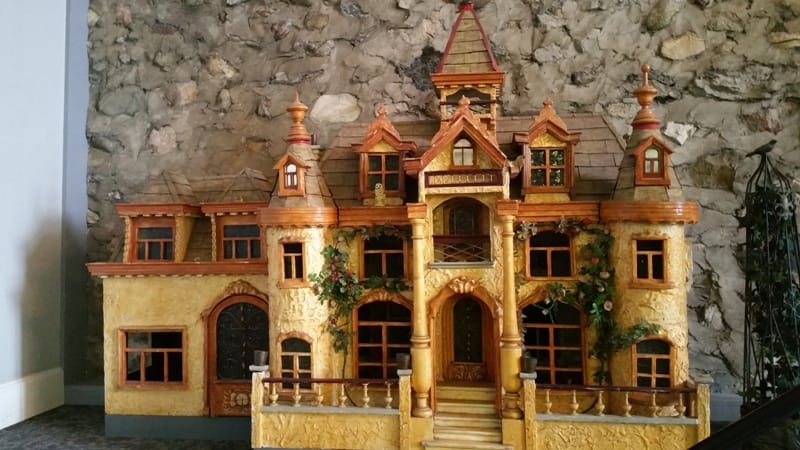
In 2010, while visiting an area antique store, Castle Farms owner Linda Mueller saw and immediately fell in love with the Castle dollhouse. “If you can find a place for it, I’ll buy it for you,” her husband Richard offered. “I already know the exact spot where to put it,” Linda said. Two days later, the dollhouse arrived at the Castle.

Entire Castle dollhouseThe Castle dollhouse dates back to the late 1890s-early 1900s. An unknown French artisan was commissioned by a wealthy aristocrat to create the piece. In the late 20th century, an American importer visiting France happened across the dollhouse at a local flea market. On a whim, he purchased it for his young children, and it was shipped to America. Years later, the importer decided to sell the dollhouse. His brother, a local antique dealer, purchased the dollhouse and kept it for a number of years before its purchase by Richard Mueller.


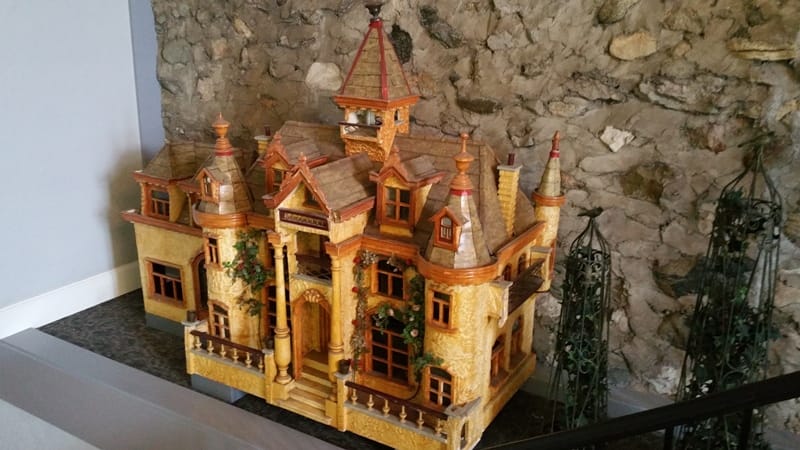
The Castle dollhouse, a true scale image of a noble French castle, invites one’s imagination. A royal Fleur-de-lis (symbol of French nobility) decorates the front entry. Latticed windows beg a peek inside. The lover’s balcony, positioned on one side, is a secluded retreat. Owls (note the owl perched atop one of the balustrades) were considered by the French to be of great nobility. Everything about the Castle dollhouse denotes a miniature royal residence.

Castle dollhouse owlCastle dollhouse interiorCastle dollhouse detailsCastle dollhouse balconyStaircase with Castle dollhouse


Dollhouses date back as far as Egyptian times, though their true popularity began in the 1700s. European royalty and aristocrats commissioned individual dollhouses as a means of portraying art and decoration. Dollhouses were normally crafted only by famous artisans, and might take years to complete. They were never meant to be used as toys, but rather, were replicas of real life. Dollhouses were symbols of status and prestige, and were often on display at various palaces throughout the courts of Europe and beyond.

The Castle dollhouse can be found to the left of the grand staircase leading upward from the King’s Gallery to the King’s Great Hall Foyer above, where it remains on permanent display.

Castle dollhouse exterior

“For now, it’s safely tucked away where it is. It’s positioned with its back to the wall, which is something I did on purpose,” Linda says with a laugh. “I know myself too well. If the Castle dollhouse was someplace I could easily get to, I’d always be buying more toy furniture and constantly rearranging it.”

Grow Yourself Some Magic

Fairy Garden Make & Take class“Do you believe in fairies?” Peter Pan asked all who might be dreaming of the Neverland. “Do you believe in fairies? Yes, we do! We believe so wholeheartedly in these whimsical creatures that the Castle is offering free specialty workshops just for fairy garden making. What’s a fairy garden? It’s a wee garden for the wee folk, and takes up only a wee bit of space on your patio, front porch, or even inside on your desk. You don’t know how to garden? The fairies don’t care. They told us long ago that there’s no right or wrong way to make a fairy garden. All they want is a little place to live. Fairy gardens make year-round gardening fun. Create a special holiday theme and swap out the décor with the changing seasons. Best of all, fairy garden magic involves the whole family. Children love hands-on projects, and watching the gardens bloom. Lighten your hearts and brighten your homes with a bit of greenery and magic grown in your very own fairy garden.

Enjoy free admission to a Castle Fairy Fairy Garden basketGarden Make & Take class. Held one evening each month throughout the summer, these hands-on classes will help you learn how to create, cultivate and maintain your own miniature fairy garden. All that’s required is a spark of imagination, plus a container. What type? Baskets, buckets, flower pots, small wagons, fish bowls (no fish, please!) and hollowed-out logs all work great. Castle Farms will provide the potting soil free of charge. The Castle also has containers, accessories, decorations and plants available for purchase.

Fairy Garden Make & Take Classes offered on Tuesday evenings at 6:30 pm, June 16, July 14 and August 11. Register here.

P.S. Tinker Bell thanks you!

Fairy Garden planterFairy Garden gnomesFairy Garden mushroom houseFairy Garden basket

Linda and Richard

All Because Two People Fell in Love

What do trains, Christmas cookies, and the Castle have in common? Read on for the delicious story of how two people fell in love…

Linda Mueller | Center of Attention PhotographyLinda Mueller, current owner of Castle Farms, was shy and bashful while growing up in the Cleveland suburb of Lakewood, Ohio. When she was a senior in high school, Linda’s parents talked her into taking speech class. “It will be good for you,” they said. At the time, Linda didn’t agree, but she’s since changed her mind. “It turned out to be a good class for me,” she says. “I got a husband!”

Linda and Richard Mueller met while in speech class together. Linda was fascinated with Richard from the beginning, but it took him until early December to ask her out for a date. They went to see a movie, and then to a restaurant which had trains running on tracks up around the ceiling high above their heads. Both of them thought the trains were awesome. A few weeks later, Linda designed special ‘train cookies’ for Richard at Christmas. Since she couldn’t find train cookie cutters, she cut them by hand, baked and decorated them, then stored them in a special tin. Richard loved the train cookies, and hid them in his desk so his family wouldn’t find them and eat them.

By New Year’s, Linda and Richard were a Richard and Linda Muellersteady item. They even ‘double-dated’ with his parents who often treated the couple to dinner and movies. Linda was intrigued by Richard and his family. While she was a quiet stay-at-home type, he and his family were always going out and doing things. Looking back, she laughs about it. “I never realized when I married him that it would result in non-stop action for the rest of my life.”

Senior prom and high school graduation came and went. At summer’s end, Richard went off to study engineering at the University of Michigan, while Linda headed to Kent State for art history. But college couldn’t keep them apart. After their freshman year, Linda (who, at the ripe old age of 19 had already decided that Richard was the man for her, and that she couldn’t wait around forever), said to him one day, “Why don’t we get married?” Richard didn’t even blink. He nodded and said, “Sounds like a good idea to me.”

Richard and Linda's Cake TopperThey were married on May 3, 1969, in a church featuring gothic arches and stone walls (just like the Castle). After they returned from their honeymoon, the newlyweds settled into married housing at the University of Michigan and Linda happily went about making their first home together. Richard (who was still a student) also worked for a small business called Domino’s Pizza. He’d started working for Domino’s in 1967, driving a delivery truck and delivering pizza to the dorms. Richard bought his first Domino’s store in 1970 as soon as he turned 21 and was old enough to sign the contracts. In partnership with his brother (and later his and Linda’s oldest son), the number grew to over 135 Domino’s Pizza stores, primarily in Mississippi and Louisiana. “Most of the profits went into real estate and investments,” says Linda, “and that worked out pretty well.” All that pepperoni helped fund the purchase of the Castle.

Linda on a ThroneLinda was still in high school the first time she saw the Castle. She’d traveled to Charlevoix with Richard and his family, who had summer ties to the area. Linda was fascinated by the great stone walls and buildings of Castle Farms. After she and Richard married, the two of them visited every time the Castle was open for events. When it came up for sale, Richard ‘bugged her’ to buy and restore the Castle, a decision she does not regret. “Richard was always bugging me to do stuff,” she says, “and even after 46 years of marriage, he’s still bugging me to do stuff today.” But when it came to buying the Castle, she didn’t rely just on Richard. A woman of deep faith, Linda put the decision into God’s hands. “It’s your choice, God,” she thought to herself. “If it’s not right for me, then I’ll accept it.” Ultimately the sale went through and in January 2002, Linda became the fourth owner of Castle Farms. Linda still puts everything in the hands of God, even after 46 years of marriage, four children, and six grandchildren later. “You just never know,” she says. “Richard and I did everything wrong, and it still worked out.”

All because two people fell in love, and some Richard and Linda greeting gueststrain Christmas cookies. It seems fitting that today, the Castle has the largest Outdoor Model Railroad in Michigan. Plus, Richard and Linda’s son Chris and his wife Karrie have their own cookie cutter web business. One of the things it sells: train cookie cutters! Linda laughs and says, “I could have used a couple of those back when Richard and I first met.”

Visit the Castle for a glimpse of Linda and Richard’s wedding cake topper. The same cake topper was used by their daughter Kathy on her own wedding cake.